
Sutter County Court Records After a Jail Arrest
After a local arrest and booking into Sutter County Jail, the first public record a family member usually sees is a jail custody record. That jail-side record can show the person's name, age, race, sex, arrest date, held-for agency, charge or warrant text, bail wording, and release date if one appears. The separate court record starts with the prosecuting decision. Sutter Superior Court explains that a criminal action is initiated for the People of the State of California by the District Attorney filing a Complaint, Information, or Indictment.
The Sutter County District Attorney's Office, led by District Attorney Jennifer Dupre, prosecutes adults and juveniles accused of felonies, misdemeanors, and infractions occurring in Sutter County. That office is the source of the formal charge filing, while Sutter Superior Court maintains the case record after filing. A roster charge is therefore not the final word on what was filed in court. For custody status, use jail inmate records; for photo policy and booking-photo requests, use jail mugshots. The court record is the best place to verify the complaint, next hearing, disposition, and whether a charge was amended, dismissed, reduced, or resolved by plea or verdict.
How to Find Court Records After a Sutter County Arrest
Start with Sutter Superior Court's online case access page at sutter.courts.ca.gov/online-services/online-case-access. The court states that the portal covers current cases and completed cases dating back to 2008, does not require registration, and can be used to view case information, view scheduled hearings, purchase copies of documents, and pay criminal and traffic fines and fees. If a case is not found, the court says the matter may not be a Sutter Superior Court case or may be confidential; confidential cases must be searched in person at the courthouse.
The official court page links into the Sutter Tyler public portal. Use the portal after checking the jail roster, because the roster may provide the spelling, arrest date, held-for agency, warrant number, or charge code needed to match the court record.
The image below comes from the Sutter Tyler portal launch screen at portal-casutter.tylertech.cloud/Portal/.
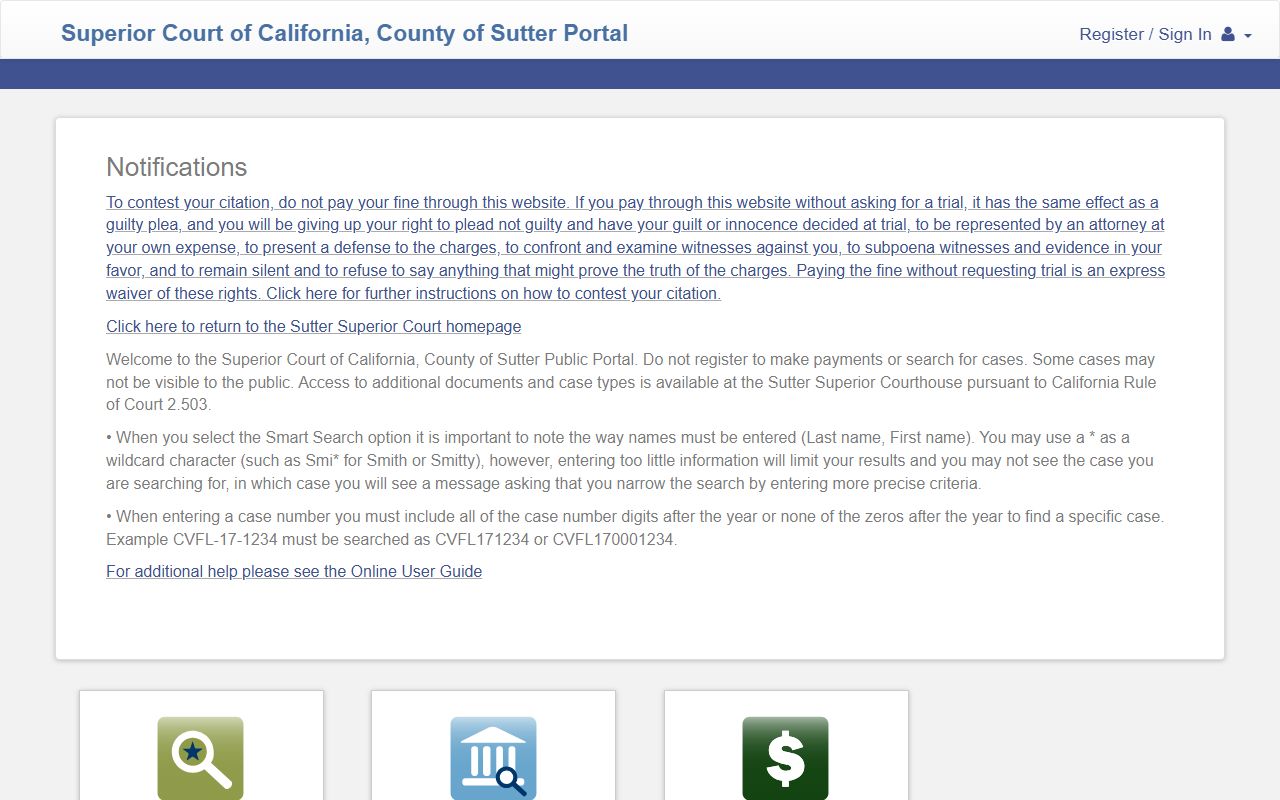
The Tyler portal is the online doorway for filed criminal case information. A new jail arrest may not appear there immediately if the District Attorney has not yet filed a charging document.
- Search the jail roster first for current custody, held-for agency, arrest date, bond text, and warrant or charge references.
- Open the Sutter Superior Court online case access page and launch the Tyler portal.
- Search by name, and use the case number if a citation, warrant, attorney, or jail record provides one.
- Open the matching case and review the charge list, scheduled hearings, financial obligations, and disposition fields that are public.
- If the case is missing, check timing, spelling, confidentiality, out-of-county jurisdiction, or a hold that has not produced a Sutter court filing.
- For older, pre-2008, archived, or not-found records, use the court records request process or search in person.
Court Portal and Records Request Fields
Sutter's research did not expose every Tyler portal field label through a text scrape, but the court confirms the portal, its 2008-current coverage, its no-registration access, and its use for case details and hearings. The court records request form provides the clearest list of identifiers that help court staff locate a criminal case after an arrest.
| Access Point | Field or Identifier | How It Helps |
|---|---|---|
| Tyler portal | Case number | Best direct match when known from a court notice, attorney, citation, warrant, or prior search. |
| Tyler portal | Name | Useful after verifying spelling from the jail roster; try last name alone if the full name format is uncertain. |
| Tyler portal | Case category or type | May narrow the search to criminal, traffic, or other public court case groups. |
| Records request form | First Name, Last Name, Organization | Identifies the requester, not necessarily the defendant, unless the description also names the defendant. |
| Records request form | Email Address, Phone Number, mailing address | Lets the court contact the requester when the request is complete or when fees are due. |
| Records request form | Case Number and description | Should include defendant name, arrest or booking date, approximate year, record type, and whether certified copies are needed. |
| Records request form | Certified Copy? and acknowledgment | Flags copy needs and confirms the requester read the payment and processing notice. |
The official records request screenshot is from Sutter Superior Court's records request form.
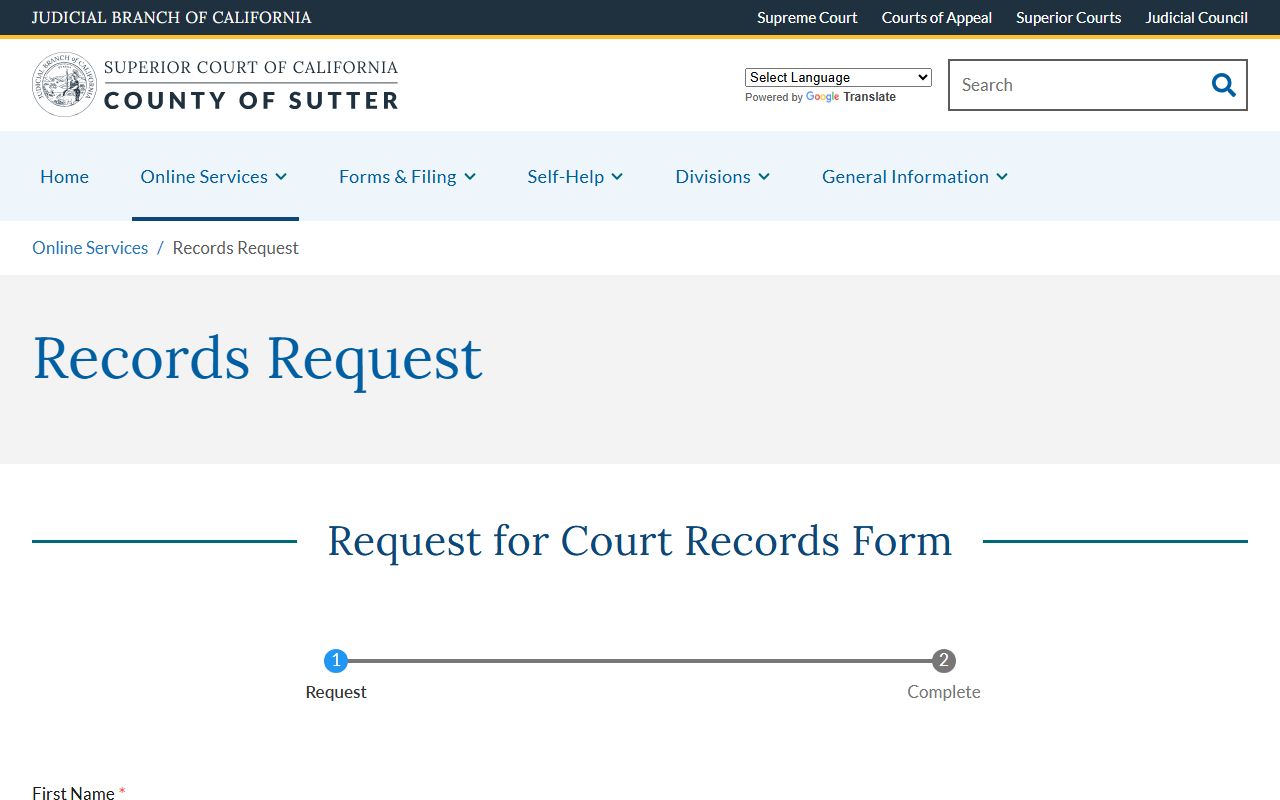
Use the description box to be precise. A strong request might ask for the public register of actions, complaint, most recent minute order, disposition, or next scheduled hearing for a named defendant and case number.
How Charges Get Filed After an Arrest: Complaint, Information, and Indictment
Booking happens at the jail, but formal court charges come from a filed charging document. Sutter Superior Court names three charging documents: Complaint, Information, and Indictment. The document type matters because it tells a reader how the criminal action entered the court system and why the visible court charges may differ from the arrest-side hold reasons on the roster.
| Complaint | Information | Indictment | |
|---|---|---|---|
| Filed By | District Attorney for the People of California | District Attorney after felony case development | Grand jury process |
| Common For | Misdemeanors, infractions, and many early felony filings | Many felony prosecutions after preliminary proceedings | Serious or grand-jury-filed felony matters |
| Starts or Advances | The criminal court case | The felony trial-stage pleading | The court case based on grand jury action |
| Why It Differs From Jail Record | May file fewer, different, or additional counts | May reflect amendments after hearings | May not match initial booking language |
Sutter court classifies crimes as felonies, misdemeanors, and infractions. A felony is punishable by state prison or death; a misdemeanor is punishable by fine and/or county jail; an infraction is punishable by fine. Those classifications should be read from the court case when available, because jail roster wording is a custody snapshot rather than a final court outcome.
Charge Status in Court Records After Arrest
Charges can change as a case moves. The jail roster may show fresh charges, warrants, commitments, parole or probation holds, added-in-court warrants, and bond notes. The court case may later show a different formal charge list because the District Attorney can file different, fewer, additional, or amended charges. Treat the court portal and court clerk as the controlling source for formal filed charges, hearing dates, dispositions, and amendments.
| Status | What It Means | Where to Verify |
|---|---|---|
| Pending | The charge is still active and has not reached final disposition. | Tyler portal, minute orders, court clerk, or next hearing notice. |
| Amended | The prosecution changed the count, code section, level, wording, or other pleading detail. | Complaint, amended complaint, information, or minute order. |
| Reduced | A charge was lowered, often as part of plea negotiations or later court action. | Court docket, plea paperwork, sentencing minute order. |
| Dismissed | The court or prosecutor ended that charge without a conviction on that count. | Disposition entry, minute order, dismissal form, or clerk copy. |
| Convicted | The charge resulted in a guilty plea, no contest plea, or verdict. | Disposition and sentencing records. |
| Warrant Activity | Failure to appear or another court event may result in a bench warrant. | Court portal, Traffic/Criminal Processing, attorney, or law enforcement after surrender. |
Bail, Warrants, and Release Pathway After an Arrest
Sutter County Jail release information and Sutter court bail information must be read together. Bail may be posted for a person incarcerated in Sutter County Jail by contacting the control room deputy at the jail lobby. Full bail may be posted with U.S. currency, cashier check, or money order; personal checks are not accepted. Cashier checks and money orders must be payable to "Sutter County Consolidated Courts." A bail bond agency may also be used.
The Sutter court website publishes bail schedules, including 2026 uniform, felony, and misdemeanor schedules. The screenshot below is from the court's bail schedules page.
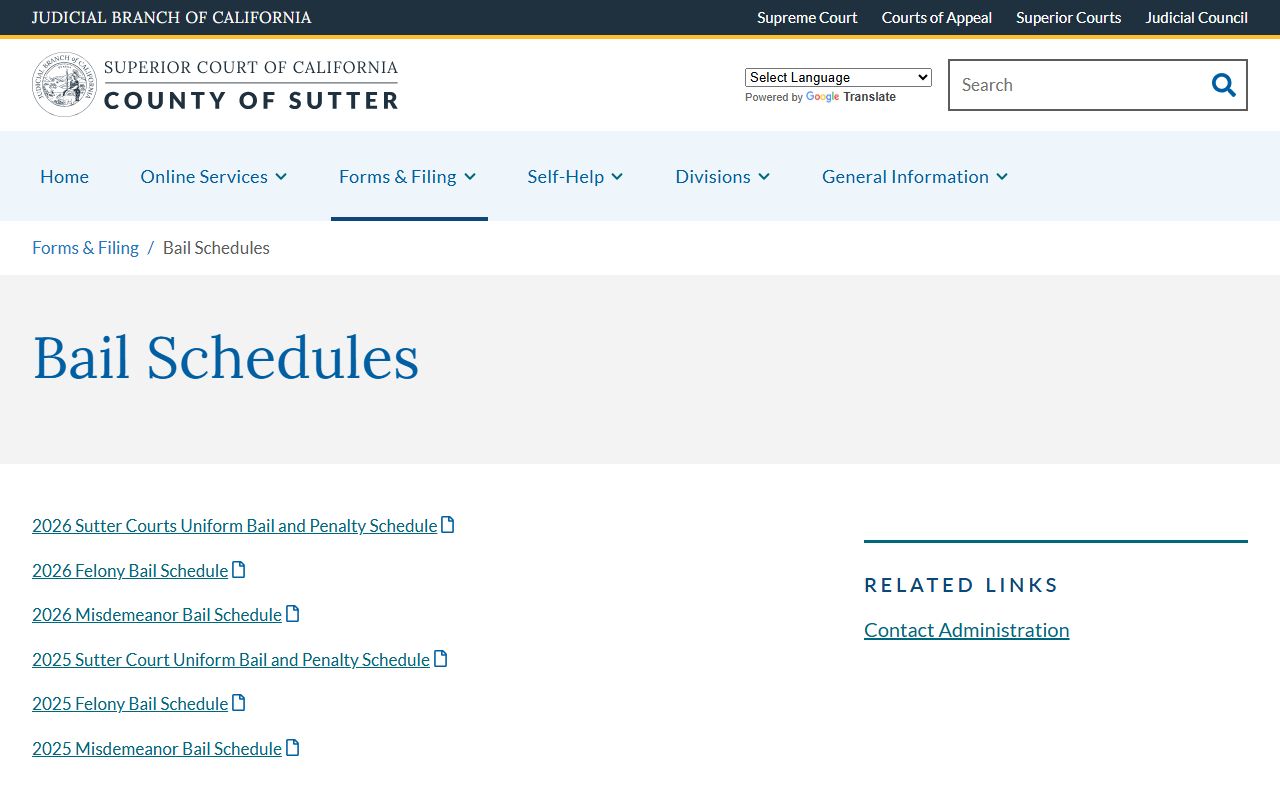
Bail schedules are only one part of release. Sutter Superior Court states that at arraignment the judge explains rights and charges, may raise, lower, or set bail, takes a plea, and appoints counsel if the defendant cannot afford one. Custody arraignments are heard daily at 3:00 p.m.
| Roster or Bail Wording | How It Works in Sutter County |
|---|---|
| Bail Bond, $amount | A public roster amount tied to a charge, warrant, or hold. Other holds can still block release. |
| U.S. currency, cashier check, money order | Official full-bail payment methods at the jail lobby. Personal checks are not accepted. |
| No Bail / No Bail, $0.00 | Money alone may not release the person. A court order, warrant, parole/probation hold, or sentence may control. |
| Sentenced-No Bail | The person is serving a sentence or commitment rather than awaiting release by bail on that hold. |
| Concurrent | The hold runs with another hold. Do not add it as a separate bail amount without confirmation. |
| 1275 Proof of Monies | Roster wording observed in Sutter data. In California, this generally relates to scrutiny of bail source under Penal Code 1275.1, so confirm with court, jail, or counsel. |
| Set By Judge | The bail or no-bail condition was set by a judicial officer and the court is the best source for change requests. |
Common release blockers include no-bail warrants, probation violation holds, CDCR/parole holds, added-in-court warrants, out-of-county warrants, state-prison commitments, and other agency holds. Confirm every hold before posting money.
Warrants That Lead to an Arrest and Court Records
No standalone official Sutter County Sheriff active-warrant search page was located in the research. Warrant information appears after booking on the public Zuercher roster when a person is in Sutter County Jail custody. Observed hold language included Ramey warrants, misdemeanor warrants, felony warrants, added-in-court warrants, and out-of-county warrant references.
Sutter Superior Court warns that scheduled court dates are mandatory in most cases. If a defendant misses a scheduled court date, the judge may issue a bench warrant. The court says Traffic/Criminal Processing can be contacted at 1175 Civic Center Blvd, Yuba City, or by phone at (530) 822-3303 during 8:30 a.m. to 4:30 p.m. for court-date questions. Once a complaint has been filed, the initial appearance may be advanced by the clerk but cannot be postponed. To clear a bench warrant for failure to appear, the court says the person must surrender to any law-enforcement agency; represented defendants should contact counsel.
Court Records Request Fees and Timing
When the portal is not enough, use the Sutter Superior Court records request form. The court says not to send payments at the initial web-request stage. Requests are processed in the order received and may take 1 to 4 weeks depending on submission volume. After the request is complete, the court contacts the requester if fees are required.
| Item | Sutter Superior Court Detail |
|---|---|
| Processing time | Web requests may take 1 to 4 weeks depending on submission volume. |
| Mail copy orders | Criminal copy orders by mail are filled within 7 to 10 working days. |
| Archive search | Pre-1994 archive cases may carry a $15 search fee per name if clerk search time exceeds 10 minutes, citing Government Code 70627(c). |
| Page copies | $0.50 per page, citing Government Code 70627(a). |
| Certified copies | $40 per document, citing Government Code 70626(a)(4), plus page-copy fees. |
| Certified family law judgments | $15 under Government Code 70674(a), relevant when the request is not a criminal case. |
| Mail payment | Checks payable to Sutter Superior Court. Do not send cash. Use "not to exceed" when the total is unknown. |
Mail payment and a self-addressed stamped envelope to Sutter Superior Court, ATTN: Traffic, 1175 Civic Center Blvd, Yuba City, CA 95993. The court asks requesters to include an email address on the check memo line when paying by check.
Sutter Court Online Case Access Coverage
The court's online case-access page is the official source for portal scope. The screenshot below comes from Sutter Superior Court online case access.
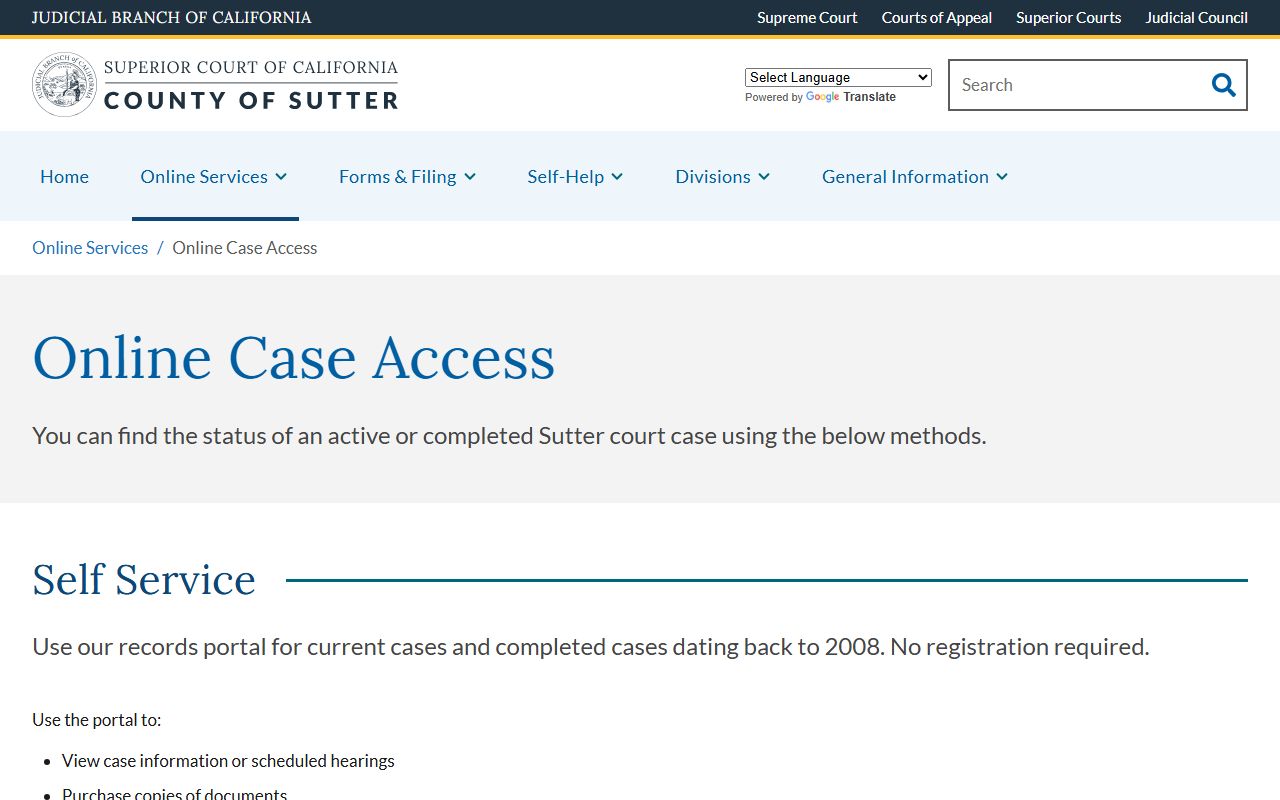
Use the 2008-current coverage limit when researching older arrests. If a person was booked on a warrant from another county, Sutter jail records may show the hold while the formal court case belongs to the issuing county or court.
Charges vs. Convictions
An arrest and a filed charge are not the same as a conviction. Sutter court's criminal materials state that the defendant is presumed innocent and that the prosecutor must prove each element beyond a reasonable doubt. The public should avoid treating jail roster hold language or a filed complaint as a finding of guilt.
| Charge | Conviction | |
|---|---|---|
| Stage | Accusation or filed count after arrest | Result of a plea, no contest plea, or verdict |
| Proof Standard | Probable cause or pleading basis, depending on stage | Beyond a reasonable doubt for trial conviction, or plea accepted by the court |
| Where It Appears | Jail hold reasons, complaint, information, indictment, docket | Disposition, judgment, sentencing minute order |
| Meaning | Not proof of guilt | Formal court outcome unless later vacated, sealed, or otherwise changed |
Sealed vs. Expunged Arrest Records
California Penal Code 851.91 allows a person whose arrest did not result in conviction to petition the court to seal arrest records if eligibility requirements are met. Sealing affects public access; it does not mean every government trace is physically destroyed. The research did not identify a Sutter-specific expungement shortcut, so eligibility and procedure should be verified through the court, counsel, or the applicable California statute.
| Sealed | Expunged / Dismissal Relief | |
|---|---|---|
| Visibility | Restricted from ordinary public access when the court grants relief. | May change how the conviction or arrest is reported, depending on statute and order. |
| Government Access | Law enforcement and courts may retain limited access under California law. | Government access may continue for specific purposes unless the order says otherwise. |
| Typical Trigger | Eligible arrest did not result in conviction, dismissal, acquittal, or comparable qualifying event. | Post-conviction or dismissal-related relief, depending on the case and statute. |
| Where to File or Verify | Sutter Superior Court case file and clerk process. | Sutter Superior Court, attorney, or California self-help materials. |
Background Check Considerations
Court case searches, jail rosters, and records requests are not substitutes for legally compliant background screening. Public records can be incomplete, delayed, confidential, sealed, amended, or tied to a similarly named person. A formal employment, housing, credit, insurance, or licensing screen has separate legal requirements.
Important: This privately operated site is not a consumer reporting agency and may not be used for any Fair Credit Reporting Act covered purpose.
Restricted Court Records After an Arrest in Sutter County
California public-access law supports access to specified arrest information, but it does not make every record public. Government Code 7923.610 requires law-enforcement agencies to release listed arrest information such as name, physical description, arrest and booking time, bail, holding or release information, and charges, warrants, or holds unless disclosure would endanger safety or an investigation. The California Public Records Act, juvenile confidentiality rules, sealed-record orders, safety exemptions, investigatory exemptions, and court confidentiality rules may still limit access.
Juvenile matters, confidential cases, sealed charges, protected victim information, sensitive investigative material, and records from another county or agency may require in-person court review, a narrower request, or legal advice. For formal Sutter criminal case records, use Sutter Superior Court. For booking records, use the sheriff Records Unit or the Sutter County NextRequest portal when the request concerns releasable law-enforcement records.